
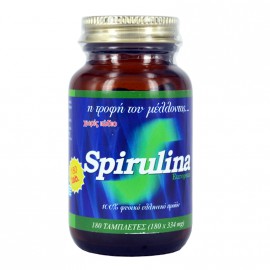

Biochemical Composition of hellenic bio-spirulina:
Spirulina contains about 100 precious substances and simple molecules thus characterized as «super food» by United Nations and «the food of the future» by NASA.
Proteins: Up to 70% on dry weight. Contains all essential aminoacids and 10 of the non-essential ones. Thus, it is a proteinic food, much better than the proteins of milk, meat or eggs, with a solubility of 95%.
Vitamins: Contains, vitamin B-1 (thiamine), B2 (riboflavin), B-3 (nicotinamide), B-6 (pyridoxine), B-9 (folic acid), B-12 (cyanocobalamin), Vitamin C, vitamin D, vitamin E, biotin, Folic acid, inositol and provitamin A.
Lipids: Contains polyunsaturated fatty acids (PUFA), especially high in Omega fatty acids, such us ?-linolenic (ALA), linoleic (LA), stearidonic (SDA), eicosapentaenoic (EPA), docosahexaenoic (DHA) and arachidonic acid (AA), Palmitic acid and oleic acid.
Metallics: Contains Calcium (Ca), potasium (K), Magnesium (Mg), Sodium (Na), manganese (Mn), phosphorons (P), Cupper (Cu), Selenium (Se), Iron (Fe), and Zink (Zn).
IT DOES NOT CONTAIN ANY IODINE.
Photosynthetic pigments: Contains chlorophyll, phycocyanin, carotenes (a and b), xanthophyls, K-anthaxanthine, b-cryptoxanthin, zeaxanthin and phycobiliproteins.
Nucleic acids: Contains Ribonucleic acid (RNA) as well as Deoxyribonucleic acid (DNA).
Special properties:
The spirulina you bought is a microscopic algal plant, produced from «seeds» provided from one of the largest Universities of Germany which has the largest algal bank internationally. As aplant it is a spectacular organism, existing on earth over 3.5 billion years, to which we owe our very existence, since it has created the first oxygen on earth we breath. It is a unique plant cultured in special raceway ponds, taking its high quality certified nutrients and the necessary photons, from the bright sun of Nigrita at Serres, Greece. Before reaching your hands it has «run» about 40 Km, the distance of a Marathon race. The nutrients offered by Spirulina to our bodies are fully water-soluble and digestable, giving extra energy, supplementing inefficiencies of modern every day nutrition, thus, maintaining a sensible right metabolic balance. Spirulina increases our capacities for body and mental work, athletics, as well as our mood for distinction wherever a modern human is active. In addition to its unique food value, certain specific features suggest its use for preventive supplementary cure in many problematic health situations, according to an official publication of the Food and Agriculture organization of the United Nations (Circular 1034, FIMA/C1034(EN), 155N 2070-6065 of 2008). The most important future is the ability of phycocyanin (found in high proportions – over 20% dry weght- in Spirulina) to effectivelly stimulate the immune system and provide protection from a variety of diseases.
More specifically:
Clinical and Lab studies indicate the positive effect of spirulina for the prevention of certain cancers, like leukemia, and because of its antivirus properties to help humans infected from HIV virus (1)
Studies made in Germany and Japan show that Spirulina effectively decreases cholesterol, esp. LDL, triglycerides as well as blood lipoproteins, protecting from atherosclerosis (2).
The proteins, vitamins, metals and polysaccharides improve substantially all body efficiencies, especialy in athletes. In weight-lifting athletes increases their lung capacity, without any adverse effect on their blood-pressure.
The dry biomass of Spirulina containing up to 2% ?-linoleic acid (GLA), which is similar to that of the human breast milk, offers help in situations like arthritis, obesity, cardiovascular, zink deficiency syndrome (esp. Anorexia nervosa).
Because of spirulina’s high content in iron, 58 times that of spinach, there is a very positive effect on the cure of low hematocrite and the menstrual syndrome (3).
Because of these spectacular properties of spirulina, in human body fitness as well as in the prevention of serious health situations, the United Nations economically support several programs of spirulina local production, esp. children, in Africa, Asia and South America.
How to consume:
The recommended dosage is 2 tablets in the morning (before breakfast) and 2 tablets before lunch, always 30 minutes before each meal, so that our body can absorb more iron.
Spirulina contains about 100 precious substances and simple molecules thus characterized as «super food» by United Nations and «the food of the future» by NASA.
Proteins: Up to 70% on dry weight. Contains all essential aminoacids and 10 of the non-essential ones. Thus, it is a proteinic food, much better than the proteins of milk, meat or eggs, with a solubility of 95%.
Vitamins: Contains, vitamin B-1 (thiamine), B2 (riboflavin), B-3 (nicotinamide), B-6 (pyridoxine), B-9 (folic acid), B-12 (cyanocobalamin), Vitamin C, vitamin D, vitamin E, biotin, Folic acid, inositol and provitamin A.
Lipids: Contains polyunsaturated fatty acids (PUFA), especially high in Omega fatty acids, such us ?-linolenic (ALA), linoleic (LA), stearidonic (SDA), eicosapentaenoic (EPA), docosahexaenoic (DHA) and arachidonic acid (AA), Palmitic acid and oleic acid.
Metallics: Contains Calcium (Ca), potasium (K), Magnesium (Mg), Sodium (Na), manganese (Mn), phosphorons (P), Cupper (Cu), Selenium (Se), Iron (Fe), and Zink (Zn).
IT DOES NOT CONTAIN ANY IODINE.
Photosynthetic pigments: Contains chlorophyll, phycocyanin, carotenes (a and b), xanthophyls, K-anthaxanthine, b-cryptoxanthin, zeaxanthin and phycobiliproteins.
Nucleic acids: Contains Ribonucleic acid (RNA) as well as Deoxyribonucleic acid (DNA).
Special properties:
The spirulina you bought is a microscopic algal plant, produced from «seeds» provided from one of the largest Universities of Germany which has the largest algal bank internationally. As aplant it is a spectacular organism, existing on earth over 3.5 billion years, to which we owe our very existence, since it has created the first oxygen on earth we breath. It is a unique plant cultured in special raceway ponds, taking its high quality certified nutrients and the necessary photons, from the bright sun of Nigrita at Serres, Greece. Before reaching your hands it has «run» about 40 Km, the distance of a Marathon race. The nutrients offered by Spirulina to our bodies are fully water-soluble and digestable, giving extra energy, supplementing inefficiencies of modern every day nutrition, thus, maintaining a sensible right metabolic balance. Spirulina increases our capacities for body and mental work, athletics, as well as our mood for distinction wherever a modern human is active. In addition to its unique food value, certain specific features suggest its use for preventive supplementary cure in many problematic health situations, according to an official publication of the Food and Agriculture organization of the United Nations (Circular 1034, FIMA/C1034(EN), 155N 2070-6065 of 2008). The most important future is the ability of phycocyanin (found in high proportions – over 20% dry weght- in Spirulina) to effectivelly stimulate the immune system and provide protection from a variety of diseases.
More specifically:
Clinical and Lab studies indicate the positive effect of spirulina for the prevention of certain cancers, like leukemia, and because of its antivirus properties to help humans infected from HIV virus (1)
Studies made in Germany and Japan show that Spirulina effectively decreases cholesterol, esp. LDL, triglycerides as well as blood lipoproteins, protecting from atherosclerosis (2).
The proteins, vitamins, metals and polysaccharides improve substantially all body efficiencies, especialy in athletes. In weight-lifting athletes increases their lung capacity, without any adverse effect on their blood-pressure.
The dry biomass of Spirulina containing up to 2% ?-linoleic acid (GLA), which is similar to that of the human breast milk, offers help in situations like arthritis, obesity, cardiovascular, zink deficiency syndrome (esp. Anorexia nervosa).
Because of spirulina’s high content in iron, 58 times that of spinach, there is a very positive effect on the cure of low hematocrite and the menstrual syndrome (3).
Because of these spectacular properties of spirulina, in human body fitness as well as in the prevention of serious health situations, the United Nations economically support several programs of spirulina local production, esp. children, in Africa, Asia and South America.
How to consume:
The recommended dosage is 2 tablets in the morning (before breakfast) and 2 tablets before lunch, always 30 minutes before each meal, so that our body can absorb more iron.
 Homeopathy & Veterinarian


